"Any damn fool can navigate the world sober. It takes a really good sailor to do it drunk." - Sir Francis Chichester when asked why he carried so much alcohol on his solo sail around the world.
My method assumes that your boat is
equipped with a two-groove headsail foil; like a harken, forespar,
etc. I'll explain how to change head-sails with hanks in another
article. My explanation also assumes that your headsail is up on the
starboard halyard. In order to not cross or foul halyards, it is very
important that before you change sails that you put the boat on the
same tack as to whatever halyard your new headsail will go up on: new
head-sail going up on the port halyard put the boat on port tack or
the new head-sail is going up on starboard halyard put the boat on
starboard tack.
Let's assume that you're sailing
on a port tack, the wind is coming over or from the port side of
your boat, so your sail is trimmed on the starboard side of the
boat.
Put your new sail on the foredeck
and attach the tack.
Pull the head through the
pre-feeder and prefeed a few feet of the luff into the port foil
groove.
Attach the port spinnaker halyard
to the head, and snug the halyard in order to take any slack out of
the halyard.
Untie the port (or lazy) sheet
from the head-sail that you have up and tie it to the clew of the
new headsail
Raise the new headsail using the
port halyard.
Tack the boat onto starboard tack.
Trim the sheets on both headsails
during the tack as if they were both attached to just one sail. Go
loose on the old sail's sheet and trim in on the new sail's sheet.
The new headsail is now on the
outside of the old sail so you can release the old sail's halyard
and pull it down. Since the old sail is on the inside of the new
sail, when you pull it down, the new sail will keep it on the deck.
Untie the sheet from the old sail
and tie it to the clew of the new sail.
Use sail ties to tie the old sail
to the foredeck or put the sail down below.
Tack back onto your original
heading or tack, if necessary.
What is great about this method is that
you pull your new sail up on the inside of the old sail and you pull
the old sail down on the inside of the new sail. By raising and
lowering sails on the inside, the outside sail keeps them on the
deck.
Note: If you only have one spinnaker
halyard, let's assume that it's on the port side. You'll raise the
new sail while on port tack and lower while on starboard tack. If
your spinnaker halyard is on the starboard side, you'll raise the new
sail while on starboard tack and lower the old sail while on port
tack.
**I'll make, and post, a video the summer of 2020 on this technique
The docks that I keep Bootlegger at have already had to be raised once,
and may have to be raised again if the Great Lake water levels continue
to go up.
Record-breaking Great Lakes water levels could be even higher in 2020
Keith Matheny, Detroit Free Press
Published 6:00 a.m. ET Oct. 11, 2019 | Updated 2:34 p.m. ET Oct. 11, 2019
It
appears 2020 won't bring relief from high Great Lakes water levels —
and they could be even higher than this past record-shattering spring
and summer.
Following a generally
rainy September, measurements by the U.S. Army Corps of Engineers
show every Great Lake, and Lake St. Clair, well above long-term monthly
average water levels for October — almost 3 feet higher on connected
lakes Michigan and Huron (35 inches) and on Lake St. Clair (33 inches).
Lake Erie is 29 inches above long-term October averages, Lake Ontario 20
inches above and Lake Superior 15 inches above.
Forecasters
now predict Lakes Michigan and Huron will start 2020 at 11 inches
higher than water levels in January 2019, said Keith Kompoltowicz, chief
of watershed hydrology at the U.S. Army Corps of Engineers in Detroit.
"The
latest forecast extends into March, and for the most part, levels are
going to be on-par with or above where they were at the same time last
year," he said.
Whether
records go even higher next summer will be determined by factors such
as snowpack and whether heavier-than-usual rains occur for a fourth straight spring, Kompoltowicz said.
Lake
Superior, Lake St. Clair, Lake Erie and Lake Ontario set new record
high water levels over the summer, with lakes Michigan and Huron an inch
or less off their 100-year highs. In July, lakes Erie and Ontario broke
their monthly records by more than 4 inches.
Across
the region, that led to flooded campgrounds and streets along Great
Lakes connected waterways, caused boating problems with submerged
structures, and caused shoreline erosion that all but eradicated some
Lake Michigan beaches.
Spooky-high water
levels for October
A wet September across Michigan has the Great Lakes and Lake
St. Clair well above their long-term average levels for October. It’s
potentially helping set the stage for another record-breaking spring and summer
of water levels next year.
Doris
Fleming has lived on Harbor Island Street in Detroit's
Jefferson-Chalmers neighborhood for more than six decades. She has seen a
lot of flooding off the nearby Detroit River in high-water years, and
this past spring and summer was among the worst, she said.
"It’s
been bad," she said. "The city has been pretty good about bringing
sandbags in. But if there’s only one opening, it messes it all up."
Flood
waters tend to move up the dead-end Harbor Island Street and into the
city blocks to the north and east, she said. "They have more problems
than we did right here" closer to the river, she said.
The news that water levels could be even higher next spring and summer worries Fleming.
"Even if it's 6 inches higher, it will cause problems," she said.
About 250 miles to the northwest, along Lake Michigan, the forecast is troublesome for Manistee city officials.
"Certainly, if it gets worse, it's a worry," City Manager Thad Taylor said.
The
city had to raise docks in its marinas to accommodate the higher water,
and suffered shoreline erosion along the river channel leading from
Lake Michigan into Manistee Lake.
"We fear losing some retaining walls," he said.
While the city's boat launches were usable, the docks were under water, Taylor said.
The
high-water problems don't go away as fall turns into winter. Last year,
the city had ice pushed by winds come ashore and damage its river walk,
Taylor said.
"It's a litany of things we've
experienced," he said. "We've had to make some repairs, and fortunately,
our municipal insurer has stood tall for us.
"We're still concerned if it goes up another 4, 5, 6 inches, we're going to experience additional problems."
This
year's record-breaking water levels were fueled by heavy spring
rains. According to the National Weather Service, metro Detroit received
5.82 inches of rain in April, almost 3 inches more than the long-term
average for the month.
"Looking across the whole
Great Lakes region, that period of January to June this year was
extremely wet," said Lauren Fry, technical lead for Great Lakes
hydrology at the Army Corps' Detroit office, who's currently serving as a
visiting scientist at the National Oceanic and Atmospheric
Administration's Great Lakes Environmental Research Laboratory in Ann
Arbor.
"We started to see less precipitation in
July and August. But water levels really came up early because of that
spring and June precipitation. The lakes take a little while to respond
to changes."
The interconnected nature of the lake system also plays a role in region-wide rising water levels, Fry said.
"If
the level of Lake Erie is high, that's going to influence the level of
the Detroit River," she said. "And that's going to propagate into Lake
St Clair, on up into the St. Clair River and eventually Lake Huron."
The
impacts of climate change on Great Lakes water levels going forward
isn't clear. Historical data shows temperatures in the Great Lakes
region are rising faster than the rest of the continental U.S., and
winter and spring precipitation, particularly via strong storms, is
increasing. Those trends are expected to continue. But modeling also
shows hotter summers and less ice cover on the Great Lakes in the
winter, which will tend to increase evaporation.
Now it all comes down to winter and spring rain and snowfall.
"If
we see another winter with a very healthy snowpack, coupled with the
flooding rains that we saw last spring, then we would be dealing with
even higher record-breaking water levels next year," Kompoltowicz said.
Even average precipitation levels would keep lake levels well above their historic averages, Fry said.
"It would take a fairly dry season, and even year, to bring things down," she said.
The mast is down and Bootlegger is finally put to rest for the winter. It took us three tries to get her out of the water: the first time was a no go because of high winds, the second time was a no go because of a death, and the third time was the charm. Always a sad time to know that Great Lake sailing is put on hold till next spring, but I think the time away makes me really appreciate the time when I am sailing. .
All that is left to do is to get the winter cover on her and then start thinking about next season. Hmmm....maybe another HOOK, a Super Mac and Back (1200 miles of solo non stop racing), Mike Kenny's Doublehanded Race and the 2X2/Solo Race, and .....
I just can't get enough of this stuff!! I wonder how the rigs hold up if they bury the bow at speed. Would think that there would be a lot of rapid deceleration trauma.
Ever since 1981, the Q Race, held (roughly) every other year on the
waters of Lake Michigan, has been run as a single- or shorthanded
freshwater distance race whose primary goal is to use one’s own
self-reliance and sailing skills, rather than cutthroat competition, to
safety complete the course. That’s not to say that the Q Race, which
starts on Friday, August 16, and which is organized by the Lake Michigan
Singlehanded Society, is a casual affair—it’s not. But rather, its
primary goal is to help develop and encourage sailors, not
over-escalated war-chest rivalries.
The Q Race starts off of Racine, Wisconsin, and takes racers some 70
nautical miles down Lake Michigan to NOAA’s south mid-lake buoy, which
serves as the course’s turning point. From there, sailors spin their
bows back towards the finishing line off of Racine.
I checked in with Mike Kenny, president of the Lake Michigan
Singlehanded Society (LMSS), via email, to learn more about the 2019
edition of the Q Race.
Can you tell us a bit about the regatta’s origins? Also, how has the regatta grown and evolved over the years?
The LMSS Q Race is run on the odd years. It was originally designed to be a qualifier event for first-time racing solo sailors.
The course is about 65 nautical miles extending over 30 nautical miles
offshore around a fixed weather buoy in the middle of Lake Michigan and
back to the starting point on the West Shore. Satisfactorily completing
the Q Race Solo will qualify you for the longer Solo Challenge that we
run on the even years. The Q Race has become more popular since we
started offering a Double Handed section several years ago.
Many [sailors] prefer the Q Race as it only takes one day to complete.
This LMSS Race is graciously sponsored by the Racine Yacht Club. Race is
run on a Friday with Awards on Saturday.
How many boats are you guys expecting this year? Also, how do these entry numbers stack up to recent comparable years?
We are expecting [that] 25 to 40 boats will enter the Q race in 2019.
This is up slightly from the average. Weather and attrition has been a
significant factor in the last couple years. But in the long term we are
seeing a slight uptick in sail racing on the Great lakes.
I attribute this [uptick] to efforts by many organizations and yacht
clubs that have beefed up efforts to promote sail racing to non-Racers
and beginning sailors. Much has been done to simplify entry into the
sport.
Can you describe the levels of competition that sailors can expect to find, once the starting guns begin sounding?
You will find no shortage of competition here. Everyone is in it to win
it. Don't be fooled by what may appear as a cruising boat alongside that
J/boat, we have some of the best sailing talent on the Great Lakes.
Conditions-wise, what’s typical for this regatta? Also, what are the best-case and worst-case scenarios?
Being a mid-August event in the Midwest the temperature is usually
ideal. Personally, I like to see 15 - 20 knots from the north or south
(Course is roughly W > E > W) but it often starts out very light
from the WNW and clocks toward the North.
Worst is the stormy years when waves can quickly exceed eight feet
and/or water spouts form nearby. As an offshore race, those are the
times that can really test your skills.
Do you have any advice or insider tips that you’d like to share with
first-time racers? What about returning racecourse veterans?
The LMSS Q Race is a wonderful event for anyone interested in solo and
short-handed sailing. We are a very friendly group of sailors with a
primary focus on everyone's safety and a secondary focus on fun.
My best advice is stop thinking about it, signup now and see for yourself.
Looking at the entry list, do you have any pre-race favorites? What about any intriguing dark horses?
It's still too early to speculate. For sure there will be plenty of
competition. However, I like to keep the sections small so there are
more winners. There is nothing like the thrill of bringing home your
brag flag
.
Can you tell us about any steps that you and the other event
organizers have taken in the last couple years to help green-up the
regatta or otherwise lower its environmental wake?
Our biggest efforts have been working towards zero plastic on the water.
Sailing offshore on the Great Lakes offers an endless supply of
freshwater that’s easily and safely filtered on board at a very low
cost. This completely eliminates to need to carry any plastic water
bottles.
Anything else that you’d like to add, for the record?
Please visit our Website at lmssonline.com Sign-up on-line and see for yourself.



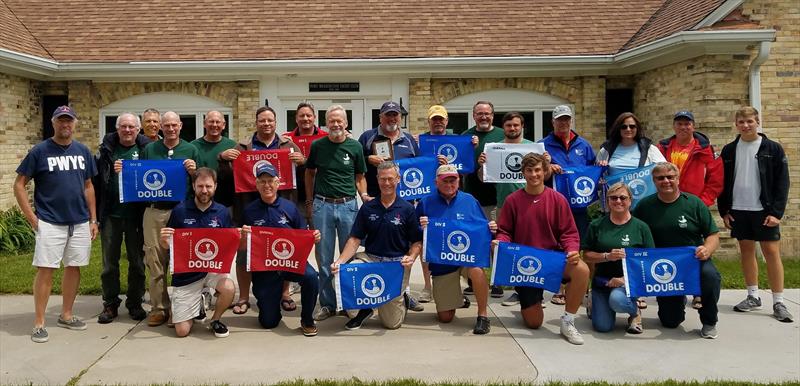 The usual suspect—Lake Michigan Singlehanded Society's Q
Race © Image courtesy of Lake Michigan Singlehanded Society/Phil Bush