"This is a picture taken of a wave crashing against the north pier
at St. Joseph, MI last Wednesday, March 8 near sunset. For the fact
junkies out there, the wind blew 40 knots, gusting 60 from the west with
a fetch of only 51nm. The brown in the wave is sand pulled up from a
depth of 20 feet.
The lighthouse seen is 57 feet high with a rear range light at 53
feet. The 36 foot tall front range and light at the end of the pier can
not be seen. Lake Michigan ain’t a place for wimpy sailors! – Anarchist Dirk."
Chichester
"Any damn fool can navigate the world sober. It takes a really good sailor to do it drunk." - Sir Francis Chichester when asked why he carried so much alcohol on his solo sail around the world.
Sunday, March 19, 2017
Friday, February 3, 2017
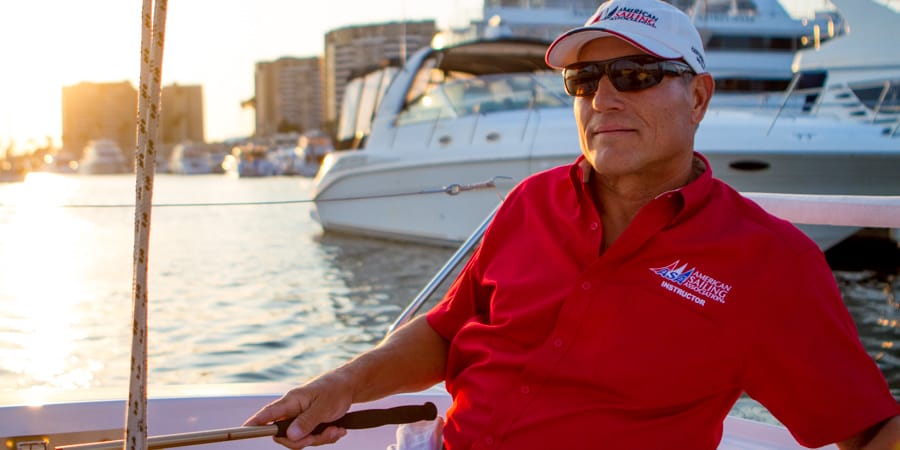
What Makes a Good Sailor?
Originally published by American Sailing Association on December 21, 2016
Written by Pat Reynolds
It’s a sentence you hear all the time – “he’s a good sailor” – an innocuous complimentary description that falls away as soon as uttered, but what does it mean? What is a “good sailor?” We’ve put together seven qualities that we think fit the bill. Feel free to add to the list.
Intuition
The top of the list is intuition. We’ve all been on boats with people who just seem to know innately, more than anyone else, where the wind is and where it’s going to be. The boat goes faster when they are in charge and they have an anticipation and understanding that is on another level. Sure, some of it is from experience, but some if it isn’t. Intuition is a magical thing and great sailors have it in spades.
Solid Understanding of Fundamentals
Of course we would say this but it’s true – core fundamentals are critical to being a good sailor. Obvious perhaps, but so many sailors have holes in their game. One walk along any dock in America and you’ll find some interesting takes on how to tie a cleat hitch. Knowing knots, points of sail, weather information, vocabulary and all of the other basics have to be second nature for a person to be a good sailor.
Jack of All Trades
MacGyver would have been a good sailor. Things go strange on boats. Fittings pop out, things fall overboard, lines snap – there’s no telling how a boisterous sea might change your day. For this, an ability to think on your feet and improvise is the quality of a good sailor. There is nothing so comforting as being around good sailors who, when faced with a problem, simply start figuring out solutions based on the materials on hand. Boats don’t carry spares of everything so innovation often reigns supreme. Some of the most ingenious creations in the universe have been developed by good sailors on long passages in small cruising boats.
Calmness

Truly good sailors are never the ones screaming and throwing tantrums. They are the ones figuring things out while someone else is screaming and throwing a tantrum. But beyond being calm under duress, good sailors are usually just calm in general. It’s a disposition that serves nearly every sailing situation and good sailors know it. To be calm is to be clear of mind and clarity is an enormous advantage when sailing. Breathe people…
A Boat is a Boat
Someone who really knows how to sail can hop on any boat and make it hum. He or she will do a quick inventory of how the particular systems on the boat operate and in a matter of minutes will be an integrated crew member or skipper working as if they have been on the boat for years.
Experience
In sailing or anywhere else, nothing substitutes for sheer experience. Miles under the keel in most instances can provide all that is needed to become a good or great sailor. In most cases, with a solid footing in the fundamentals, it brings with it the aforementioned calmness, the quick understanding of any boat’s systems, the ability to innovate and improvise. Although experience might not be able to provide God-given intuition like the Russel Coutts’ and Jimmy Spithills of the world, it will certainly take you farther down the road than most.
Holding Your Rum

And lastly a good sailor has to be able hold their rum. It’s been a time-honored tradition and it will always be this way. If you are throwing up in a parrot mask you donned after your seventh margarita you lose points. There’s too much at stake to be a lousy drinker. Have fun but stay cognizant – you can dance that weird dance of yours and still think about whether the anchor is holding…Link to the original article:
Tuesday, January 31, 2017
Training Your Brain in the Off-Season
Below is an excellent article on how to improve your sailing skills, or for that matter most anything. I use a similar technique to the one mentioned in the article to rehearse and improve upon a lot of my skills. Enjoy, Dave
Published on January 30th, 2017
by Dr. Tim Herzog, SpinSheet
If you take some time off this winter, that doesn’t mean that you have to stop training altogether. Serious sailors do physical conditioning in the off-season, but what about mental conditioning?
One skill I frequently tackle with sailors is mental imagery: seeing in your mind’s eye what it is you want to do, whether it’s big picture strategy, sailing new venues, remembering old venues, overcoming adversity, boat-on-boat tactics, or boatspeed and boathandling.
Good imagery is not just visual. As a good book does, it vividly taps into all the senses. Imagery combined with long exhales is also a good way to rehearse being habitually amped enough to focus without drowning in anxiety.
There’s no substitute for actual practice, but adding imagery to your regimen can help. Classic sport psych experiments show us that folks perform better with physical practice than with no practice, better with imaginary practice than with no practice, but best when combining physical practice with imaginary practice.
The old-school approach to imagery is to close your eyes and either self-generate images or be guided through self-generating images with a recorded script. One problem with self-generated images, however, is that your brain doesn’t have to generate images nearly as often during actual racing.
Sure, there are times when you soak up the scene in front of you, quickly size up what you see, and create an image to work with. For instance, Lightning World Champion Geoff Becker says that he has honed the ability to take a mental snapshot of what he sees on a race course leg, quickly creating a moving aerial view in his mind so that he’s able to clearly see how things will play out.
Starts and mark roundings are other places where momentary/spontaneous on-the-water imagery can help with making sound, fast tactical decisions. But much of successful racing boils down to habitually being present with what’s in front of you.
How can you train your mind to focus on what’s most relevant? Off-the-water imagery training can make it a habit. Sometimes, using a whiteboard or notebook for strategy/tactics or video for boathandling can help make an image more vivid. Most any prop can be used.
Many years ago, when Annapolitan Robbie Deane went off to sail for Boston University, he reported learning breakthroughs through dialogue with coach and teammates in between billiard games, where pool balls represented “sailboats.” This helped him develop that knack for being able to “see” tactical situations via an aerial view.
Twelve years ago, for my dissertation, I created “video-imagery,” whereby sailors could watch sailing video while also listening to an imagery script. The video uses a third person perspective (from the coach boat) and a first person one (from the sailor’s head). The viewer is able to passively soak up some material (as we do in real life), while memorizing what to reproduce, hopefully with less mental effort, through imagery. Sailors are encouraged to then use it with eyes closed, listening to a script with fewer words.
We found that sailors had more confidence in this approach than with the old-school method, and we found that with both approaches, sailors’ imagery ability improved after just a few sessions.
In 2004 to get the footage, I was duct-taping a video-camera in a drybag on to a snowboarding helmet. My technique was “cutting edge.” Now, in this era of GoPro cameras on the boat and filming from drones above, getting images of what happened around the race course is easier than ever! Software, such as RaceQs, allows us to visually review how a race went tactically, moment to moment. With the video-game SailX, we can also practice having to make quick tactical decisions, and learn from good or bad consequences.
These tools can be combined with aspects of other imagery. As you watch replays of inside the boat or from above, you can engage what you see as if you’re doing it yourself right now, “feeling” the actions, such as driving, communicating to the helmsperson, and experiencing all the sights, sounds, and smells that make it feel a little more real. Even better, you can pause it and practice many more imagery repetitions of how you wanted it to play out (rather than how it actually went), to drill in what you’re learning.
You can even take it a step further with exercise. Consider Jimmy Spithill’s quote: “…if you can’t anticipate and make decisions under stress and exhaustion and think ahead, then you won’t be able to cut it.”
We’ve moved a long way from billiard balls and duct-taped cameras. Try some video-imagery with your smart phone at the gym. Or with a small laptop, why not have some SailX time on the exercise bike, to practice making good decisions while fatigued? Just as I did with video-imagery in 2004, you can think outside the box in 2016-17.
About the Author: Dr. Tim Herzog is a Mental Performance Coach and a former college coach.
reachingahead.com
Source: Spinsheet, December 2016
If you take some time off this winter, that doesn’t mean that you have to stop training altogether. Serious sailors do physical conditioning in the off-season, but what about mental conditioning?
One skill I frequently tackle with sailors is mental imagery: seeing in your mind’s eye what it is you want to do, whether it’s big picture strategy, sailing new venues, remembering old venues, overcoming adversity, boat-on-boat tactics, or boatspeed and boathandling.
Good imagery is not just visual. As a good book does, it vividly taps into all the senses. Imagery combined with long exhales is also a good way to rehearse being habitually amped enough to focus without drowning in anxiety.
There’s no substitute for actual practice, but adding imagery to your regimen can help. Classic sport psych experiments show us that folks perform better with physical practice than with no practice, better with imaginary practice than with no practice, but best when combining physical practice with imaginary practice.
The old-school approach to imagery is to close your eyes and either self-generate images or be guided through self-generating images with a recorded script. One problem with self-generated images, however, is that your brain doesn’t have to generate images nearly as often during actual racing.
Sure, there are times when you soak up the scene in front of you, quickly size up what you see, and create an image to work with. For instance, Lightning World Champion Geoff Becker says that he has honed the ability to take a mental snapshot of what he sees on a race course leg, quickly creating a moving aerial view in his mind so that he’s able to clearly see how things will play out.
Starts and mark roundings are other places where momentary/spontaneous on-the-water imagery can help with making sound, fast tactical decisions. But much of successful racing boils down to habitually being present with what’s in front of you.
How can you train your mind to focus on what’s most relevant? Off-the-water imagery training can make it a habit. Sometimes, using a whiteboard or notebook for strategy/tactics or video for boathandling can help make an image more vivid. Most any prop can be used.
Many years ago, when Annapolitan Robbie Deane went off to sail for Boston University, he reported learning breakthroughs through dialogue with coach and teammates in between billiard games, where pool balls represented “sailboats.” This helped him develop that knack for being able to “see” tactical situations via an aerial view.
Twelve years ago, for my dissertation, I created “video-imagery,” whereby sailors could watch sailing video while also listening to an imagery script. The video uses a third person perspective (from the coach boat) and a first person one (from the sailor’s head). The viewer is able to passively soak up some material (as we do in real life), while memorizing what to reproduce, hopefully with less mental effort, through imagery. Sailors are encouraged to then use it with eyes closed, listening to a script with fewer words.
We found that sailors had more confidence in this approach than with the old-school method, and we found that with both approaches, sailors’ imagery ability improved after just a few sessions.
In 2004 to get the footage, I was duct-taping a video-camera in a drybag on to a snowboarding helmet. My technique was “cutting edge.” Now, in this era of GoPro cameras on the boat and filming from drones above, getting images of what happened around the race course is easier than ever! Software, such as RaceQs, allows us to visually review how a race went tactically, moment to moment. With the video-game SailX, we can also practice having to make quick tactical decisions, and learn from good or bad consequences.
These tools can be combined with aspects of other imagery. As you watch replays of inside the boat or from above, you can engage what you see as if you’re doing it yourself right now, “feeling” the actions, such as driving, communicating to the helmsperson, and experiencing all the sights, sounds, and smells that make it feel a little more real. Even better, you can pause it and practice many more imagery repetitions of how you wanted it to play out (rather than how it actually went), to drill in what you’re learning.
You can even take it a step further with exercise. Consider Jimmy Spithill’s quote: “…if you can’t anticipate and make decisions under stress and exhaustion and think ahead, then you won’t be able to cut it.”
We’ve moved a long way from billiard balls and duct-taped cameras. Try some video-imagery with your smart phone at the gym. Or with a small laptop, why not have some SailX time on the exercise bike, to practice making good decisions while fatigued? Just as I did with video-imagery in 2004, you can think outside the box in 2016-17.
About the Author: Dr. Tim Herzog is a Mental Performance Coach and a former college coach.
reachingahead.com
Source: Spinsheet, December 2016
Friday, January 27, 2017
Peterson Wiggers 37, Lotus, used in ads
The ads below feature Lotus, a Peterson/Wiggers 37 owned and campaigned by Sy Kaback.
"TEAM "LOTUS" - 1983 SUCCESS STORY
This team effort began early in the year with Bill Kelly visiting the Wiggers plant in Canada and deciding on the Petersen 37. A great deal of engineering and planning between Bill Kelly, Tom McLaughlin and Andy Wiggers resulted in the final product.
Despite the late delivery of the mast, McMichaels finished the installation of the instruments, rigging, etc. in time for us to enter the American Spring Regatta. David Silberkleit returned from his ski hiatus to take care of all the details and get the "Lotus" race ready.
In every series that we entered this year we finished first or second in class. Among these wins were:
Riverside Yacht Club Press On RegardlessThe highlight of the season was the gratifying first place win in the I.O.R. Class 5 at Block Island. Class 5, with 35 yachts, was undoubtedly the most competitive class at the Storm Trysail Yacht Club's Block Island Race Week.
Spring Plus Fall Series
First in Class
Indian Harbor Yacht Club - Whitmore Series
Spring plus Fall Series
First in Class
New York Yacht Club
2nd in Class
There were (5) Wiggers Petersen 37's each equipped by a different sailmaker, as well as "Lindy", the prototype Petersen 38. Farr was represented by "Migize" (won 5 of 6 races in the S.O.R.C.) and (2) new Farr 37's "Sugar" and Mandala". Bruce Nelson was aboard the Nelson-Marek 39 foot "Conamore". "Stajon" and the other Nelson-Marek boats were in our class. "Messenger" and the latest German Frers creations were present with outstanding crews.
Lack of wind prevented anyone in our class finishing race #1 and consequently everyone started out with 35 points. Without this handicap, our total for the remaining races would have put us in line for overall fleet winner. (over 300 yachts) En route to block island, we managed to come in first in the I.O.R. class in the Sag Harbor Y.C. -Drug Abuse Race.
During the summer season, "Lotus" won the Eastern Long Island Yachting Association Championship - a 10 race series, and was the ELIYA "Boat of the Year". Overall wins included the Shelter Island Yacht Club Heatherton Trophy, the Eastern Sailing Club Annual Regatta and the East Hampton Yacht Club Bowl Regatta. In Local East Hampton Yacht Club Gardner Bay races, "Lotus" won (2) firsts and (1) second.
Additional kudos go to:
Andy Wiggers - Wiggers Yachts
Tom McLaughlin of North Sails
Hathaway-Reiser and Raymond Rigging
Offshore Outfitters
Sager Restaurant - Sandwiches
| * * * * * * * * * |
Bill Kelly Tom McLaughlin David Silberkleit Richard Mintzer David Florence Schyler Earl Colin Kelly Andy Wiggers Art Ellis Richard Bitlingmeier Peter Celone Peter Coleman Tom Dailey Peter Davis Hugh Frazer John Holmes Eric Keikrug Tricia Kelly Rob Kemp Bizzy Monte-Sano |
* |
Scott Delaney Kevin Fallon Daniel Fallon Glen Feit Derek Galen Greg Gordon Wayne Hoyt Bill Lyons Rudy Ratsup Colin Golding |
| * | Crewed at Block Island" | ||
Sunday, January 22, 2017
Matthew Driving Back to Chicago After the 2015 Solo Mac
He's a whole lot better sailor than I was at his age. This summer, 2017, Matthew and I will do some Great Lakes double-handed races together.
Thursday, January 12, 2017
Short Handed Sailing Advice
Below is a reply to a question, not by me, about doing the 2017 Bermuda 1-2 Race. The reply is from a very experienced Class 40 solo racer named Mike Hennessy, owner of Dragon, and it offers some really good advise on short handed sailing. Enjoy.
"In general, if you think about doing a race like this, it starts with having a boat that is capable and ready to do a passage like this one. In that regard, the prep is no different than if you were going to do the same course fully crewed or 1-2. The short handed aspects of this type of racing increase the demand on the skipper at having a multi-disciplinary skill set (navigator, sailor, sail maker, boat builder, electrician, mechanic, carpenter, composites engineer, etc.). And it adds the need to understand and be capable of sleep management. Other than that, my own experience is that short handed is more in your head than anything else
There are a few areas to focus on if you are wondering how-to. In no particular order:
Above all, remember that it is a great adventure and you are surrounded by a great group of people even if you are alone out there."
"In general, if you think about doing a race like this, it starts with having a boat that is capable and ready to do a passage like this one. In that regard, the prep is no different than if you were going to do the same course fully crewed or 1-2. The short handed aspects of this type of racing increase the demand on the skipper at having a multi-disciplinary skill set (navigator, sailor, sail maker, boat builder, electrician, mechanic, carpenter, composites engineer, etc.). And it adds the need to understand and be capable of sleep management. Other than that, my own experience is that short handed is more in your head than anything else
There are a few areas to focus on if you are wondering how-to. In no particular order:
- Sail inventory. Beyond a main that can be deep reefed and your primary Jib, you are going to need something to reach with (Jib Top or Code), something to run with (spin), a headsail to use in heavier breeze and a storm jib. They need to be in good repair, cuz who wants to be stuck out there trying to get to Bermuda and also repairing sails. And you have to be comfortable with changing them on your own. For cost alone, this is one of the more difficult things to get done,
- Deck hardware & rigging - make sure it is in good repair and serviced well. Check every nut, bolt, cotter pin, clevis ring, splice, and turnbuckle. Things that fail you inshore are typically an irritant. Things that fail you offshore can get you in deep trouble.
- Electronics - make sure you check every connection, every cable. If it looks a bit corroded at the dock, you can be sure it will short once you get out there, and then you won't be able to find it while you are wondering why your autopilot is behaving erratically.
- Spares. If you can not survive without it, you should have a spare. If you can survive without it, then you probably should not have it at all.
- Safety gear. You need to own a bunch of it. Or be able to borrow it. This can get pricey too.
- Comms. Plan on buying or renting a sat phone
- Auto pilot. Probably the most important piece of kit on the entire boat. Make sure you have one that works.
- What to wear. Remember, it is actually bloody cold between the Stream and shore. And then hot and muggy from the Stream to the Island. Spinlock vest & harness. Kong tether. Musto HPX bibs and jacket. Musto or Dubarry boots. fleece jacket. 1 pair of shorts, 1 pair of long pants. Long sleeve wicking shirt (2 or 3 of them). Smart Wool long underwear. Underwear (the days you expect to take X .80). Hat for the sun, and a watch cap. That is it. Anything more is a waste of weight and space. Who cares if you stink like a goat.
- Navigation. You should have at least a basic understanding of weather systems and their impact on your routing. Ideally, you should be able to go into the Vendee Globe thread and have at least some grasp of the concepts that some of the posters are talking about when discussing the choices being made by the likes of Armel or Alex. You can plot your course on paper charts (and in some respects that is a great discipline to follow), or you can master Expedition, but none of it does you any good if you don't know what the weather is going to do with your boat. You can take classes to help with that, or borrow time from someone who knows how to do it.
- Learn about the Gulf Stream. There are lots of resources, starting with the background and prep sessions done for this race and the Newport Bermuda. But the Stream really is a unique aspect of this course, and is worth knowing how it impacts your race.
- Sleep Management. Roy used to arrange for a seminar for the skippers interested in doing the race, taught by Claudio Stampfe. I took it twice, and found it helpful. You need to learn how to nap, and how to nap well.
- Confidence. Get out there and sail solo as often as you can, in as many different conditions as you can
- Perspective. Just remember, its not like you are giving birth, climbing Everest or that world peace hinges on completing the course. You can always turn back. And it really is only a few days of sailing - its not like you are going to Mars on a 5 year journey. So don't turn it into something bigger in your head, and don't let it psych you out.
Above all, remember that it is a great adventure and you are surrounded by a great group of people even if you are alone out there."
Tuesday, December 27, 2016
Foggy Solo Spinnaker Sailing on Bootlegger
There was an incredible amount of wind gradient when this was taken; on the water there was almost no wind and at the mid-mast level about 15 kts. Taken in 2015 while practicing for the Solo Mac.
Subscribe to:
Posts (Atom)